Login
Login


 24x7 Customer Care
 Visit Our Store


Shri Jagannath Mandir, Delhi
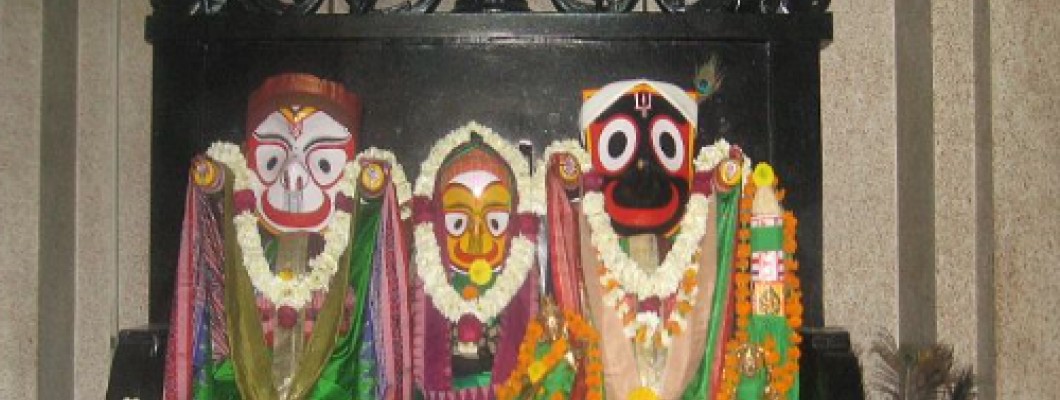
Situated in Delhi, Shri Jagannath Mandir is a famous temple dedicated to Lord Jagannath. The temple was established by a group of non-resident Odias in Delhi, by forming a society named Orissa Arts & Cultural Centre. The foundation stone of the temple was laid on 15th January 1968 and the construction work started on 5th February 1968. Initially a small temple was built and small size idols of Lord Jagannath, Lord Balbhadra and Maa Subhadra was installed inside the temple. The foundation stone of the new and present structure of the temple was laid by Late Justice R.N.Mishra on 23rd January 1991. The Pratistha Ceremony was inaugurated by His Excellency Shri Dibya Singh Deo, Gajapati Maharaja of Puri on 28th January 1999.
location Delhi, Delhi, Delhi
Legend
According to the legends, Lord Jagannatha was worshipped as
Nila Madhava, the family deity of an aboriginal chief secretly at this spot.
The King of Malwa, Indradyumna was a great devotee of Lord Vishnu and he has an
immense wish to see Lord Vishnu in his most perfect form on the face of the
earth. Once in a dream, King was told that Lord Vishnu could be seen in his
best form in Utkala (another name of ancient Odisha). The King deputed
Vidyapati, the brother of royal priest to find that temple. Vidyapati came to
know that Lord Jagannatha was worshipped as Nila Madhava and was the
family-deity of Visvavasu, a Savara (an aboriginal tribe) chief. However, the
chief refused to show Vidyapati the temple after he approached the chief with
the request. Later, Vidyapati married the Lalita, the daughter of the
aboriginal chief. Even after that, the chief refused to show him the temple.
After the request of Latita, teh chief took Vidyapati blindfolded to a cave on
a hillock where Nila Madhava was being worshipped. On his way, Vidyapati
managed to drop mustard seeds on the ground and after the seeds germinated
after a few days, it was easy for Vidyapati to trace the way to the lonely cave
of Nila Madhava. Vidyapati returned to Malwa and informed the King about the
place. Indradyumna immediately set out on a pilgrimage to Odisha; however, when
he reached there, the idol of Nila Madhava had miraculously disappeared from
that place. Later, Indradyumna received a divine direction to go to the
sea-shore at Puri and to draw ashore a log of wood that would be floating on
the waves from which the idol of Lord Vishnu can be fabricated in a befitting
manner. The king found the log; however, as nobody has seen Lord Vishnu they
couldn't convince the king as to how Visnu could be fabricated in his best form
out of a log of wood. Later, Lord Vishnu disguised as a carpenter and convinced
the King about his capabilities. however, the carpenter asked the King to allow
him to remain in a closed room with the log of wood for long twenty one days to
do the needful and gave a warning that under no circumstances he should be
disturbed or the door be opened before the specified date. However, the Queen
persuaded the king to open the door before the specified date as no sound of
any kind was heard from within. When the door was opened at the king's command,
no trace of the carpenter could not be found and a set of four wooden images of
Jagannatha, Balabhadra, Subhadra and Sudarsana in incomplete form was found.
Architecture
Built as per Odisha style of architecture, there is Simhadwar
at the front of the temple with 22 number of steps called "Baishi
pahacha" leading to Mukhashala. In front of Mukha shala, there is a pillar
called "Aruna stambha" built in marble stone facing the Chaturdha
Deities. The images of many other gods and goddesses like Shri Baraha, Shri
Narasimha and Shri Bamana etc. have been engraved outside the structure of the
main temple.
Culture
The culture of Delhi represents the culture of all the
states of India in parts. In other words, it is a kind of synthesis and
reflection of the culture of India, as a whole. Being the capital of India, New
Delhi has also become the main center of politics, from where all the decisions
are made and policies passed. However, the city does have a history of its own
which has made some impact on its cultural scenario.Delhi comes as a merger of
the modern lifestyles as well as the old traditions and values. On one hand, we
can see the Old Delhi still living in the past to some an extent and still
upholding the values of the past. While, on the other we see culture in New
Delhi where people have become slaves of ostentations. There is the sound the
Qawwalis of Nizamuddin Shrine, Gurbanis of Bangla Sahib and Aartis of
Chattarpur Mandir. At the same time, one can hear the loud and blaring music of
pubs and discotheques.
Darsan Info
Morning at 5:00 A.M T0 10:00 PM (SUMMER) / 5:00 A.M T0 9:00
PM (WINTER)
It is tradition that before entering the main temple each
devotee touches/embraces Aruna stambha.
Darsan Dresscode
Shri Jagannath Mandir, Delhi
Famous Festival
Harishayana Ekadashi / Sunabesha, Ratha Yatra,Guru
Purnima, Pithe Dushahera ( Suna Besha)
Temple Rituals
Mornig pooja and arati starts from 05:30 AM
Additional Info

Karim's Mughlai Restaurant, Cosy, Imperfecto, Naivedyam

Related Products